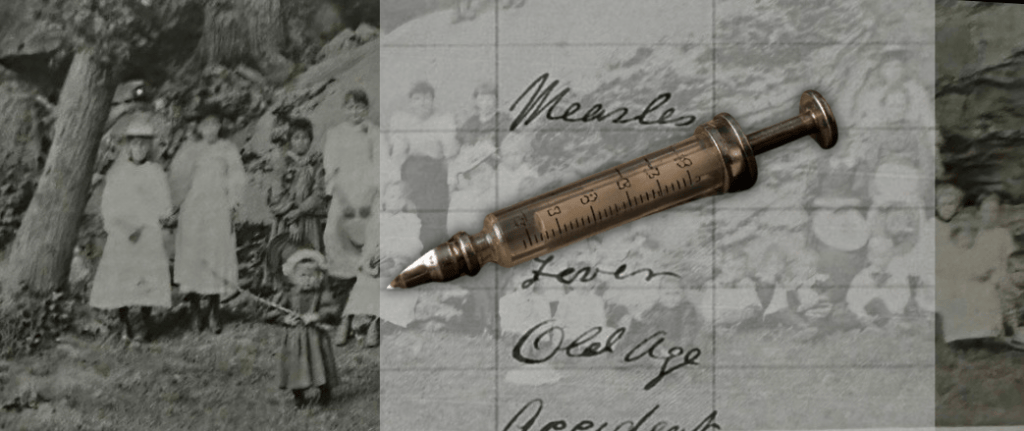
This last week, a case of measles was confirmed here in Fillmore County.
Under ordinary circumstances, that news would concern me. But this time, it hit a little differently.
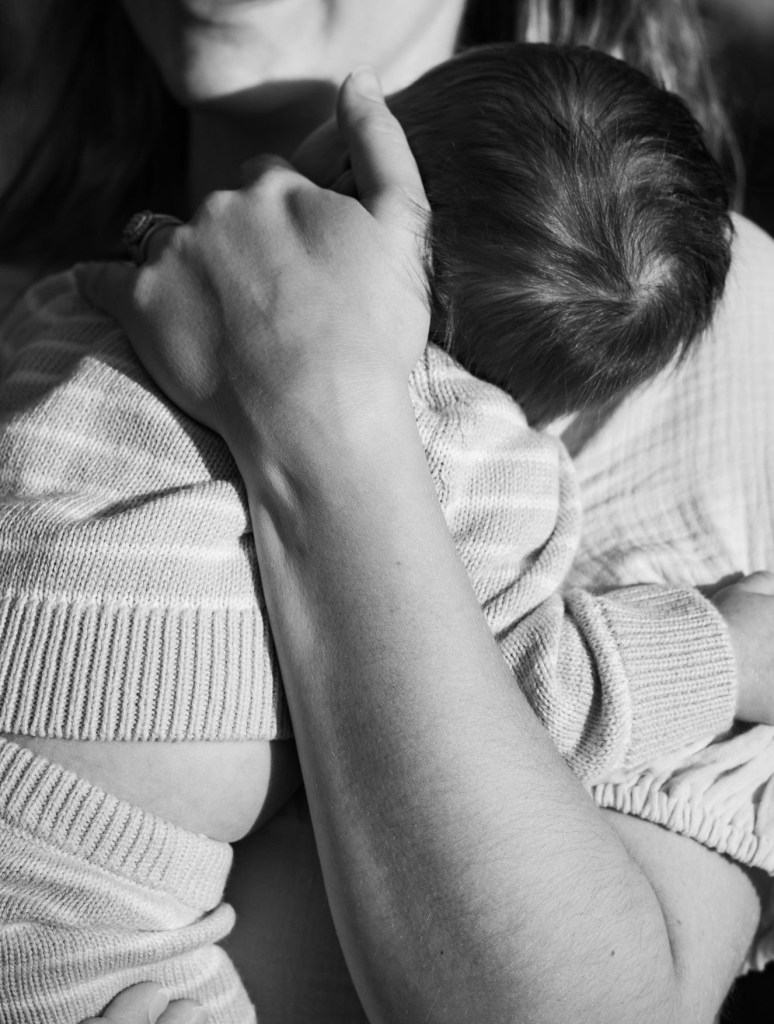
I have a newborn at home.
He is only a few weeks old—far too young to receive his first MMR vaccine. Like every baby his age, he is among the people who benefit when those around him are protected from measles.
So when I heard that measles had made its way into my own county (after years of it being essentially eradicated), my first reaction was as a mom.
My second was as a genealogist.
Because when I hear about diseases like measles returning, my mind immediately goes backward.
I think about the records I spend so much of my time reading. Death certificates. Cemetery registers. Obituaries. Old newspapers. Census records.
And I think about the children.
One of the great privileges of genealogy is getting to know people who lived long before us. But there is another side to genealogy that isn’t nearly as romantic.
Spend even just a brief time reconstructing families from the 1800s and early 1900s and you quickly see just how many children didn’t make it to adulthood.
Sometimes an infant appears in one census and is gone by the next. Sometimes an obituary tells you what happened. Sometimes a cemetery contains several tiny stones belonging to children from the same family.
And sometimes the record actually tells you the disease that killed them.
The people who weren’t “just fine”
I frequently hear some variation of the argument that generations before us got measles and survived it.
That’s true, most did.
But as a genealogist, I spend a lot of time with the records left behind by the people who weren’t “just fine.”
While researching this week, I decided to see what I could find about measles right here in Fillmore County.
I didn’t have to look far. Within minutes of my research I was able to find evidence of measles in Fillmore County’s past.
In March 1869, measles was sweeping through Preston.
The Preston Republican described one household in which all five children had been “prostrated by measles,” with every case requiring special care.
But it wasn’t just one unfortunate family.
The writer added that many neighbors were in similarly bad condition and estimated that half of the children in town were sick or had recently been sick.
Just imagine that for a moment.
Half of the children in your community.
Then I started looking for the people who didn’t recover.
And I quickly found them too.
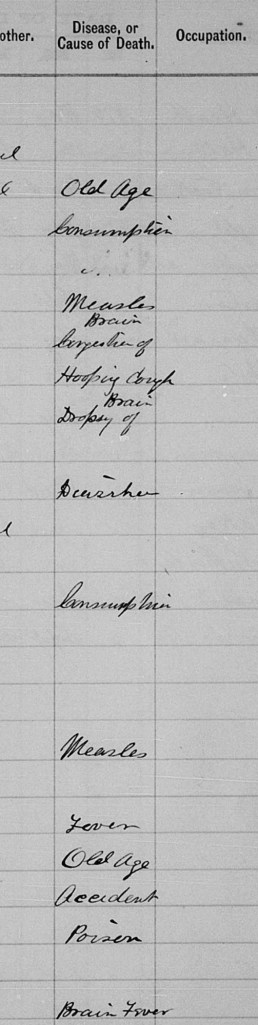
In the historical death records for 1870, I found at least three Fillmore County residents whose deaths were attributed to measles:
Emily McGrew — 41 years old — Jordan Township — March 23, 1870
Julia Ann Henderson — 8 months old — Fillmore Township — May 10, 1870
Cora Bell Howe — 9 months old — Bristol Township — May 23, 1870
Two of them weren’t even a year old.
And then I learned more about Emily.
Four children orphaned in three days
The March 26, 1870, edition of the Chatfield Democrat carried a memorial for John McGrew.
John had died, leaving behind his wife, Emily, and their children.
But before the newspaper was even published, another piece of news arrived.
Emily had died too.
Her cause of death was measles.
The newspaper reported that Emily’s death left four orphaned children who had lost both their father and mother within the space of three days.
Three sons and one daughter.
The youngest was only four years old.
As a genealogist, those are the moments when history stops feeling distant.
I can picture those children.
I can imagine a four-year-old who doesn’t understand why Mom and Dad are suddenly gone. I can imagine relatives trying to determine what happens next. I can imagine a household that looked completely different in the span of three days.
And then there are Julia and Cora.
Eight months.
Nine months.
Two baby girls living in different parts of Fillmore County who died just thirteen days apart, both from measles.
These weren’t people living somewhere far away during some epidemic I’ve read about in a history book.
They lived here.
Their families walked the same communities we do. They raised their children in the same county where we’re raising ours.
Our ancestors absolutely got measles.
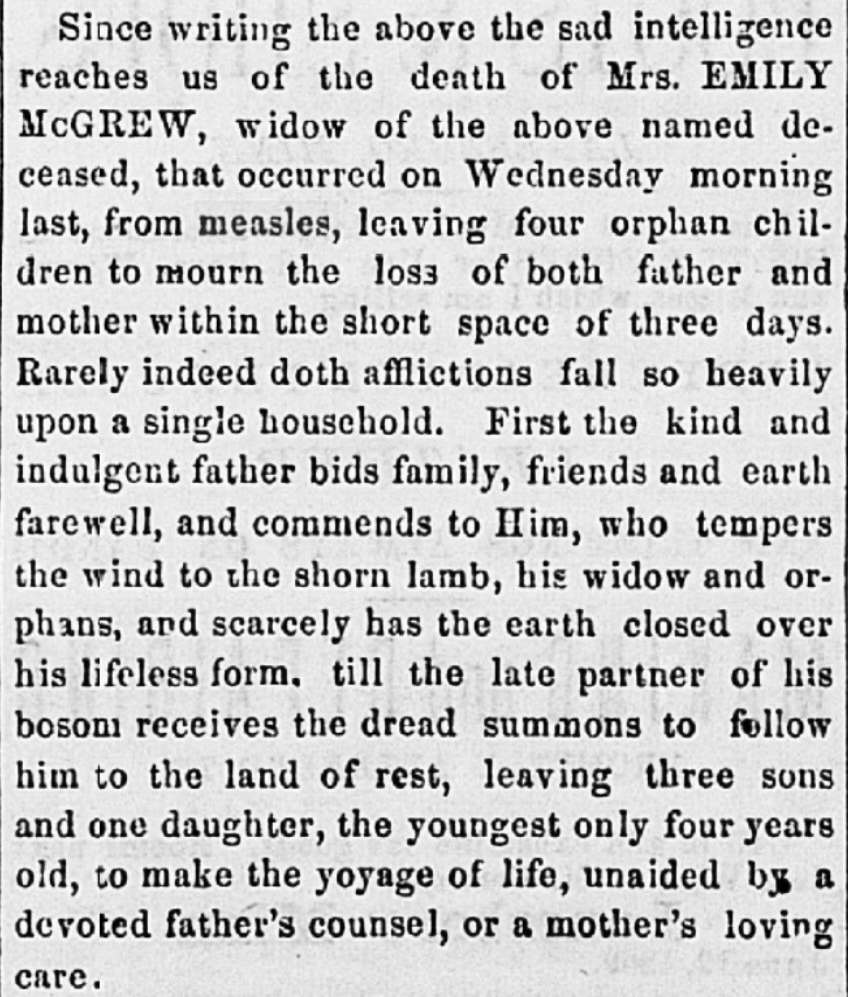
March 26, 1870 Chatfield Democrat. Accessed via MNHS Newspaper Archives
Childhood used to look very different
It can be easy to romanticize the past.
Our ancestors grew their own food. They spent more time outdoors. They lived without many of the chemicals, processed foods and technologies surrounding us today.
There are plenty of things about their lives worth admiring.
But I’ve spent enough time in historical records to know there was another side to that world.
Children died at a rate that is almost unimaginable to American parents today.
Across historical populations, researchers estimate that roughly half of children once died before reaching the end of childhood. Even around 1800, more than one-third of children in many populations died before reaching their fifth birthday.
Today, childhood mortality in the United States is a tiny fraction of what it once was.
That transformation wasn’t caused by one thing.
Clean water mattered.
Sanitation mattered.
Better nutrition mattered.
Antibiotics and modern medical care mattered.
And vaccines mattered.
The world our ancestors inhabited wasn’t simply our world without smartphones and processed food.
It was a world in which losing a child was a much more ordinary part of family life.
Parents buried children.
They feared diseases that most of my generation has had the extraordinary privilege of barely thinking about.
Measles was one of them.
Before the measles vaccine
The first measles vaccine became available in the United States in 1963.
Before then, measles was so common that nearly every child contracted it at some point. The CDC estimates that in the decade before the vaccine became available, approximately 3 to 4 million people in the United States were infected every year.
About 500,000 cases were reported annually. Of those, roughly 48,000 people were hospitalized, about 1,000 developed encephalitis, and 400 to 500 died each year.
Those numbers matter because measles can sometimes be discussed today as though it is simply an unpleasant rash and fever.
For most people, measles resolves without permanent harm.
But “most” has never meant “all.”
Measles can cause pneumonia. About one child in every 1,000 who contracts measles develops encephalitis, which can cause convulsions and leave a child deaf or with intellectual disability. One to three of every 1,000 children who become infected may die from respiratory or neurologic complications.
Then vaccination dramatically changed the equation.
In 2000, measles was declared eliminated in the United States, meaning continuous transmission of the disease within the country had been stopped.
For an entire generation of American parents, measles became something we knew mostly from history.
And now measles is here
As I write this in September 2026, Minnesota has reported measles cases this year.
And now one of those cases is here in Fillmore County.
The confirmed case involves an unvaccinated adult, and public health officials have been working to identify people who may have been exposed.
That is particularly concerning to me because I currently have someone in my home who cannot protect himself.
As a newborn, he isn’t old enough to receive the routine MMR vaccine.
With that, the conversation surrounding measles feels considerably less theoretical.
Because while researching this article, I found Julia.
Eight months old.
And Cora.
Nine months old.
Their parents couldn’t reap the benefits of herd immunity. And today parents could lose that benefit as well if vaccination rates continue to drop.
Vaccines have become victims of their own success
I think there is a strange paradox in the way we talk about vaccination today.
The better prevention works, the less frightening the thing being prevented becomes.
My generation generally doesn’t know what a measles outbreak looks like.
We don’t remember polio wards.
Most parents have never sat beside a baby struggling through whooping cough.
We don’t expect diphtheria to sweep through our children’s classrooms.
We inherited that luxury.
And when a disease disappears from everyday life, eventually it becomes easier to fear the prevention more than the disease itself.
Genealogy gives me a different perspective.
The historical record doesn’t allow me to pretend these diseases were harmless simply because modern medicine has made them unfamiliar.
I can open a Fillmore County newspaper from 1869 and read that half the children in Preston were reportedly sick or had recently been sick during a measles outbreak.
I can look at Fillmore County’s death records the following year and find an eight-month-old baby in Fillmore Township and a nine-month-old baby in Bristol Township whose cause of death was measles.
I can open another local newspaper and find four children whose mother died from measles just three days after their father died.
And I can give those people names.
Julia Ann Henderson.
Cora Bell Howe.
Emily McGrew.
History becomes much harder to dismiss when the statistics become people.
History leaves receipts
I understand why parents ask questions about vaccines.
I actually think we should ask questions about medical decisions. We should understand risks. We should understand benefits. We should know what the evidence says and make informed decisions for ourselves and our children.
But history deserves a place in that conversation too.
When evaluating the risks of vaccination, we shouldn’t compare vaccination to a world in which nothing happens.
The other side of that equation is the disease.
And unlike our ancestors, most of us have never experienced what widespread circulation of these diseases actually looks like.
They did.
Their records are still here.
That’s one of the things I love most about genealogy. The people who came before us left behind evidence of the lives they lived, the things they celebrated—and the things they endured.
Sometimes that evidence is a birth certificate.
Sometimes it’s a wedding announcement.
Sometimes it’s a newspaper clipping.
And sometimes it’s a line in an old death record:
Cause of death: Measles.
One hundred and fifty-six years ago, two Fillmore County families buried babies named Julia and Cora after measles took them before their first birthdays.
Today, I have a baby of my own who isn’t old enough to receive his MMR vaccine yet.
And that’s perhaps the part of this history that feels most personal to me.
Right now, I can’t give him the added layer of protection.
He is too young to be vaccinated against measles. For now, he has to rely in part on the immunity of the people around him; the same protection we sometimes call herd immunity.
Julia and Cora lived in a world where no one around them could be vaccinated against measles.
My son lives in a world where they can.
As a genealogist, and as a mom, that isn’t something I take for granted, and hope it’s something our community doesn’t lose.

 Legacy Lane Genealogy