A Mother’s Day Reflection on Boys, Mitochondrial DNA & Generational Threads
Mother’s Day feels different when you are a genealogist.
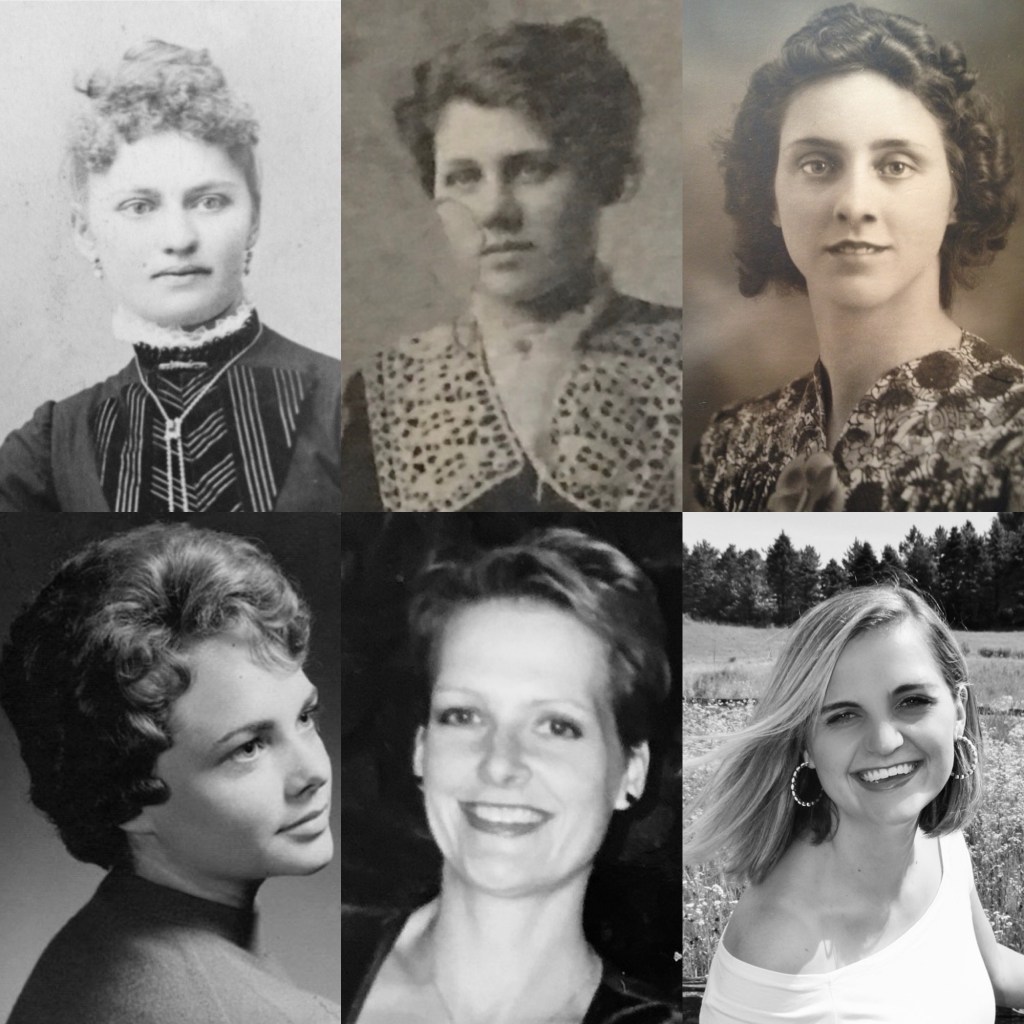
While I partake (and enjoy) in celebrating with brunch reservations and bouquets, I also always find myself tracing invisible lines — mother to daughter, back through time. I think about the women whose names I have written in careful script on pedigree charts. The women whose recipes, baptismal gowns, letters, and lullabies made their way into my hands.
And this year, I’ve been thinking about something else.
I am the last woman in my direct maternal line.
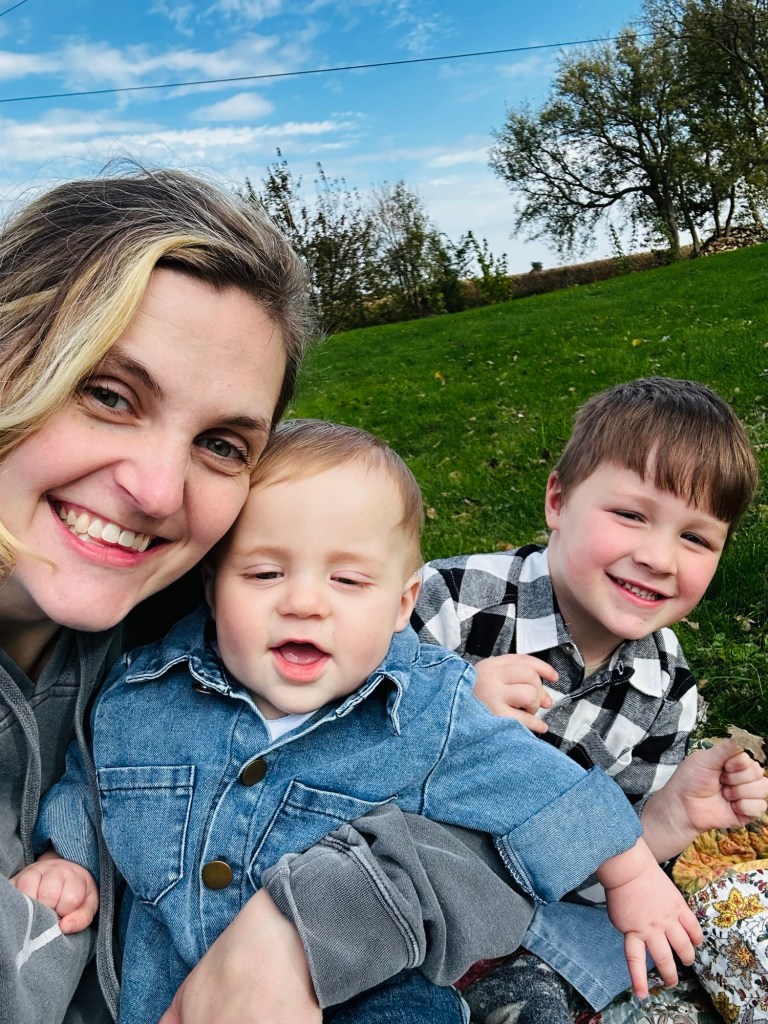
I am a boy mom.
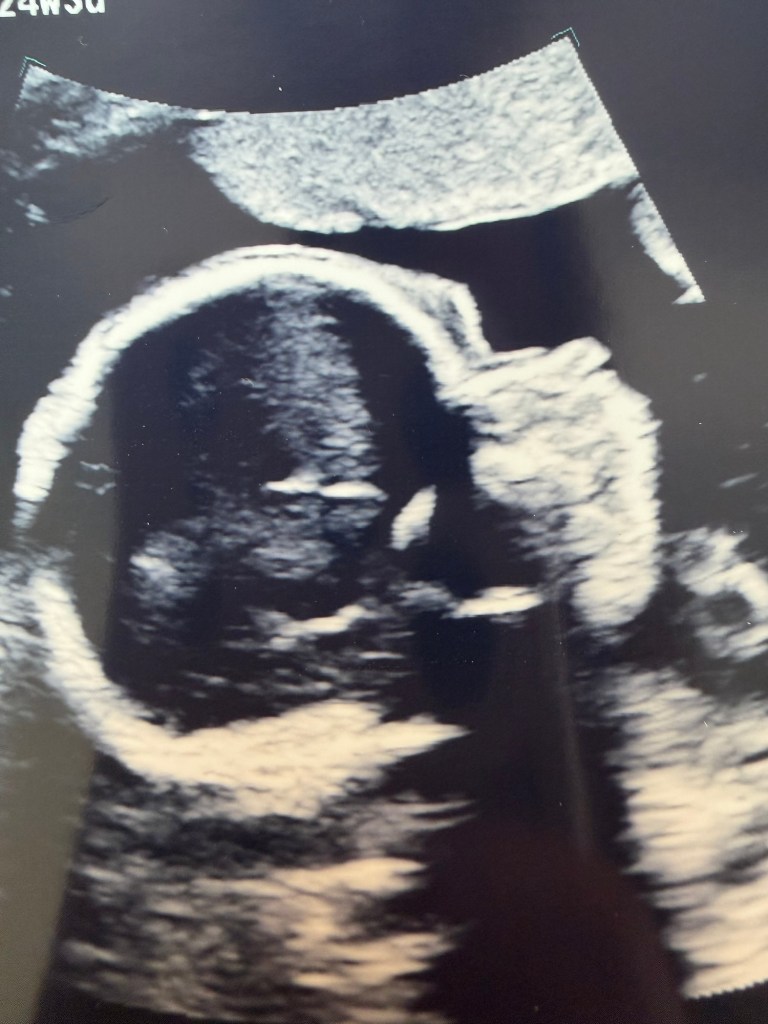
I am expecting my third — and likely final — son.
And my sister… she has only boys too.
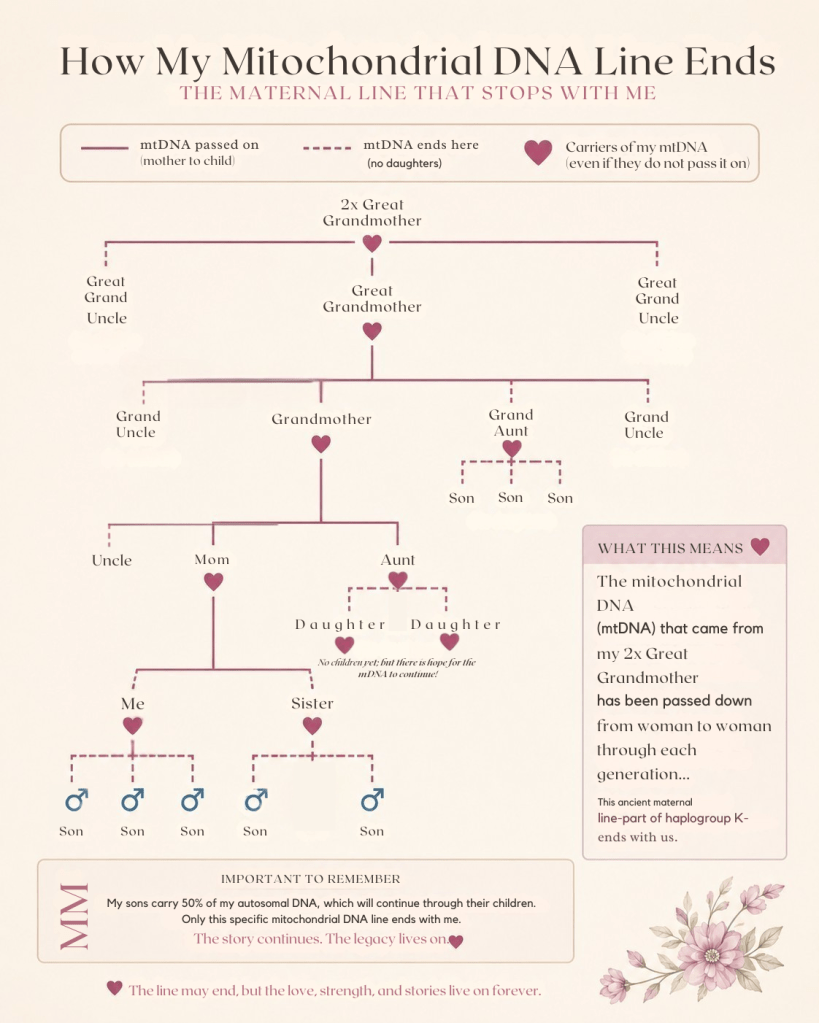
There are no daughters coming behind us to carry this particular biological thread forward.
Even more striking — this pattern doesn’t end there.
On my father’s side, the mitochondrial line has already ended. My dad had one sister… and she, too, only had boys.
Two maternal lines. Two endings.
Not by choice. Not by design.
But somehow… together.
Unless something unexpected happens, the mitochondrial DNA that passed from my mother to me — and from her mother to her — will not continue beyond my generation.
And yet… the more I understand it, the more I realize this isn’t just an ending.
It’s something far more extraordinary.
The Most Ancient Line We Carry
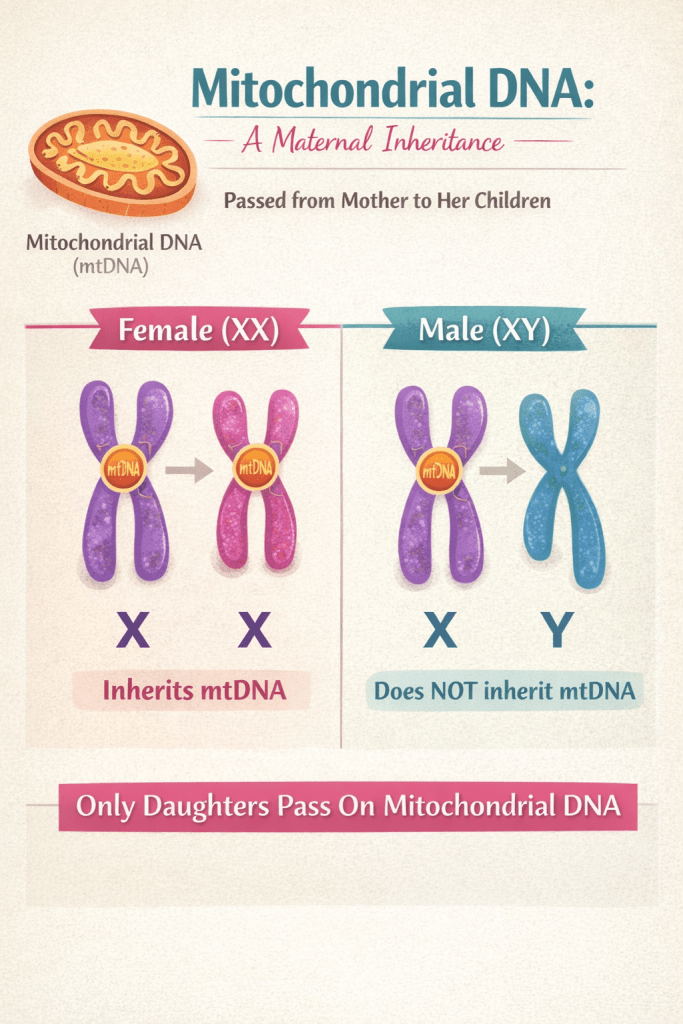
Mitochondrial DNA is unlike any other kind of DNA we inherit.
While most of our DNA — called autosomal DNA — is a mix from both parents and reshuffles every generation, mitochondrial DNA (mtDNA) is passed almost unchanged from mother to child.
Only daughters pass it on.
Which means this:
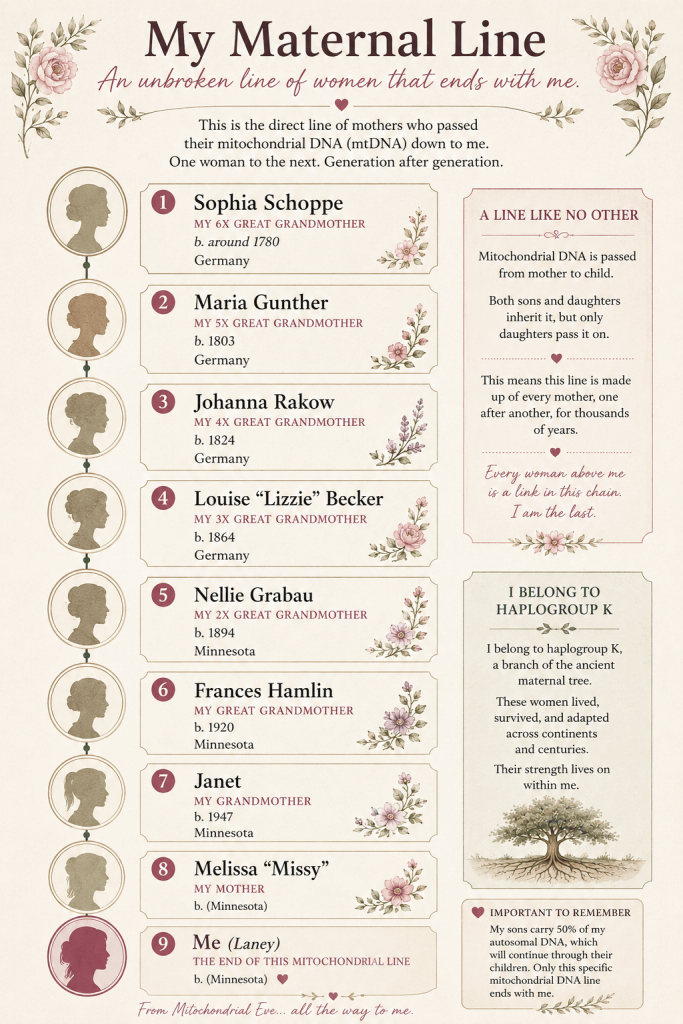
Your mitochondrial DNA is a direct, unbroken line of mothers stretching back through time.
Not hundreds of years.
Not thousands.
But tens of thousands — even hundreds of thousands — of years.
Every single mother.
One after another.
Without interruption.
Scientists often refer to this origin point as “Mitochondrial Eve” — the most recent common ancestor from whom all living humans inherited their mtDNA.
And somehow… that same thread made its way to me.
I belong to haplogroup K — a branch of that ancient maternal tree, carried by women who lived, survived, and adapted across continents and centuries.
Women who endured things I will never fully comprehend.
Women whose names I may never know.
But whose presence lives on — quite literally — inside my cells.
That’s what makes mitochondrial DNA so incredible.
It is not just science.
It is memory.
What Ends… and What Does Not
As powerful as that maternal line is, it’s also important to understand what this does not mean.
This does not mean my DNA ends with me.
Far from it.
My sons will carry 50% of my autosomal DNA — the DNA that shapes who I am in countless visible and invisible ways.
My traits.
My features.
My genetic story.
That continues.
It will be passed on again through their children, just in a mixed and evolving form.
What is ending is not my DNA as a whole — but one very specific, unbroken thread of it.
A thread that has remained unchanged for thousands of generations.
And maybe that’s what makes it feel so significant.
Because it is both incredibly small… and unimaginably vast at the same time.
When You Start Looking Closely…
One of the things genealogy has taught me is that patterns reveal themselves when you start paying attention.
And when I started looking at the maternal lines in my own family… I couldn’t unsee it.
On my paternal grandmother’s side — a line I don’t personally inherit mitochondrial DNA from, but can still trace — there were four sisters and one brother. Between them, fifteen children were born.
Fifteen chances for that mitochondrial line to continue.
And yet, from what I’ve been able to identify so far, only one descendant is still carrying that line forward today.
One.
On my maternal side, the pattern is just as striking.
My great-grandmother was the only daughter in her family.
My grandmother had just one sister — and she only had boys.
When you lay it out like that, it almost stops you in your tracks.
Not because it feels random… but because it doesn’t.
As genealogists, we’re trained to look for patterns in records.
But sometimes, the patterns are living.
Some lines stretch endlessly through time.
Others narrow quietly until they rest in a single set of hands.
When a Line Comes Full Circle
As a genealogist, I’ve spent years preserving names so they won’t be forgotten.
I’ve walked cemeteries.
I’ve scanned faded obituaries.
I’ve pieced together women whose identities were reduced to “Mrs. So-and-So.”
I’ve fought to restore them to history.
And yet, here I stand — pregnant with my third son — at the end of a biological chain that has never been broken… until now.
It would be easy to see that as loss.
To feel the weight of being “the last.”
But I don’t.
Because the more I sit with it, the more it feels like completion.
Not an ending.
A closing of a circle that has been forming for longer than we can truly grasp.
The Belief About Boys & Broken Curses
There’s an old belief — whispered in different ways across cultures — that when a woman has only sons, it signals the breaking of a generational curse.
That something heavy… something unspoken… stops there.
Whether you see that as spiritual truth or symbolic meaning, it resonates.
Because every family line carries both beauty and burden.
Strength and silence.
Resilience and wounds.
And maybe this isn’t coincidence.
Maybe it’s transformation.
Maybe what was once carried forward no longer needs to be.
What Actually Continues
My sons carry my DNA.
They carry my autosomal DNA — which will continue into future generations.
They carry the strength of women who came before them.
The resilience of my haplogroup K ancestors.
The stories I choose to give them.
Even if one biological thread ends, so much more continues.
Because legacy is not just what is passed through cells.
It is what is passed through lives.
A Sacred Ending… and a Living Legacy
This Mother’s Day, I am not grieving the end of a biological thread.
I am honoring it.
For hundreds of thousands of years, an unbroken chain of mothers carried this mitochondrial story forward. Through wilderness and war. Through birth and loss. Through faith and fear.
And now… that sacred thread rests with me.
Not as a burden.
But as an honor.
I do not see myself as the end.
I see myself as the final chapter of something ancient. Something intentional. Something entrusted.
God allowed that line to continue — unbroken — all the way to me.
And He has entrusted me with its closing.
What a holy thing.
To carry something so old.
To understand it.
To honor it.
I am both bridge and bookend.
The line may end.
But the legacy does not.
Because legacy lives in the stories we preserve… the healing we choose… and the generations we raise differently.
And if you’ve ever wondered about the line of women behind you — the ones whose strength you carry, whether you realize it or not — I would be honored to help you uncover their story.
Because every maternal line matters.
And every story deserves to be remembered.